
Helical Piles vs. Push Piers: Which Foundation Repair Method Is Right for Your Home?
Foundation instability is a critical issue that affects millions of homeowners across the United States. According to recent industry data, approximately 25% of all homes have some form of water damage, which often correlates with soil instability and foundation settlement. When a foundation begins to sink or shift, the structural integrity of the entire building is compromised. Homeowners are frequently faced with the decision of choosing between helical piles and push piers. Both systems are engineered to stabilize sinking structures, but they operate on different mechanical principles and suit different soil conditions. Understanding these differences is essential for making an informed repair decision that protects your property's long-term value. (About Walder Foundation Products)
What Are Helical Piles?
Helical piles are a type of deep foundation support system that resembles a giant screw. They consist of a central steel shaft with one or more helical bearing plates welded to it. These piles are mechanically twisted into the ground until they reach a load-bearing soil layer or bedrock. The installation process is clean and does not require heavy excavation equipment, making it ideal for tight spaces or interior applications. (All Products Page 1)
Helical piles are a steel support system installed by torqueing them into the earth to transfer structural loads to stable soil layers. This method provides immediate load-bearing capacity because the helical plates grip the surrounding soil effectively. They are particularly effective in areas with loose or unstable topsoil where traditional shallow foundations fail.
At Walder Foundation Products, we supply high-quality helical pile components, including lead sections and extensions, designed to meet rigorous engineering standards. Our inventory ensures that contractors and DIYers have access to the durable materials needed for successful installations.
What Are Push Piers?
Push piers, also known as resistance piers, are driven into the ground using the weight of the structure itself. Hydraulic jacks are used to push steel pipes through the unstable soil until they reach a competent load-bearing stratum. Once the pier is in place, the foundation is hydraulically lifted and secured to the pier.
Push piers are a driven foundation support system that uses hydraulic pressure to force steel columns into the ground beneath a structure. This method relies on the friction and end-bearing capacity of the soil layers it passes through. While effective in many scenarios, push piers require significant access to the foundation perimeter and the weight of the building to function correctly.
For those interested in the structural components of push piers, Walder Foundation Products offers a comprehensive range of Dynamic Piers and push pier brackets. These components are engineered to withstand the immense forces generated during the lifting and stabilization process.
Key Advantages of Helical Piles
Choosing helical piles over push piers offers several distinct advantages, particularly in terms of installation efficiency and soil adaptability.
1. Installation in Difficult Access Areas
Helical piles can be installed in areas with limited access. Because they are screwed in rather than driven, they require smaller equipment. This makes them ideal for interior foundation repairs or homes with tight side yards. Push piers, by contrast, often require heavy machinery that cannot fit through narrow gates or over landscaping.
2. Minimal Vibration and Noise
The installation of helical piles generates minimal vibration. This is crucial for historic homes or structures with existing cracks that could be exacerbated by the hammering action of push pier installation. According to geotechnical engineering principles, reduced vibration helps maintain the integrity of the surrounding soil and the existing foundation structure.
3. Immediate Load Capacity
Helical piles provide immediate load-bearing capacity upon installation. There is no need to wait for concrete curing or soil settlement. This allows for faster stabilization of the foundation. In contrast, some pier systems may require additional time for the soil to settle around the driven pipes.
4. Performance in Expansive Soils
In regions with expansive clay soils, helical piles are often preferred. They can be installed deep enough to bypass the active soil zone, which expands and contracts with moisture changes. Push piers may be affected by this movement if they do not reach sufficient depth. Environmental factors such as moisture content play a significant role in soil stability, making deep foundation support essential.
Limitations of Push Piers
While push piers are a reliable solution, they have specific limitations that make helical piles a better choice in certain scenarios.
Access Requirements
Push piers require heavy hydraulic equipment to drive the pipes into the ground. This equipment needs significant space to operate. If your home is surrounded by dense landscaping, fences, or other structures, push piers may not be feasible. Helical piles can be installed with smaller, more maneuverable equipment.
Soil Conditions
Push piers rely on the ability to drive pipes through the soil. In rocky or dense gravel soils, driving piers can be difficult or impossible without specialized equipment. Helical piles, being screwed in, can often navigate through rocky layers more effectively by cutting through the material.
Structural Weight Dependency
Push piers require the weight of the structure to be driven into the ground. For lighter structures or those with minimal weight, additional ballast may be required to install the piers. Helical piles do not have this dependency, making them versatile for a wider range of building types.
Comparison of Repair Systems
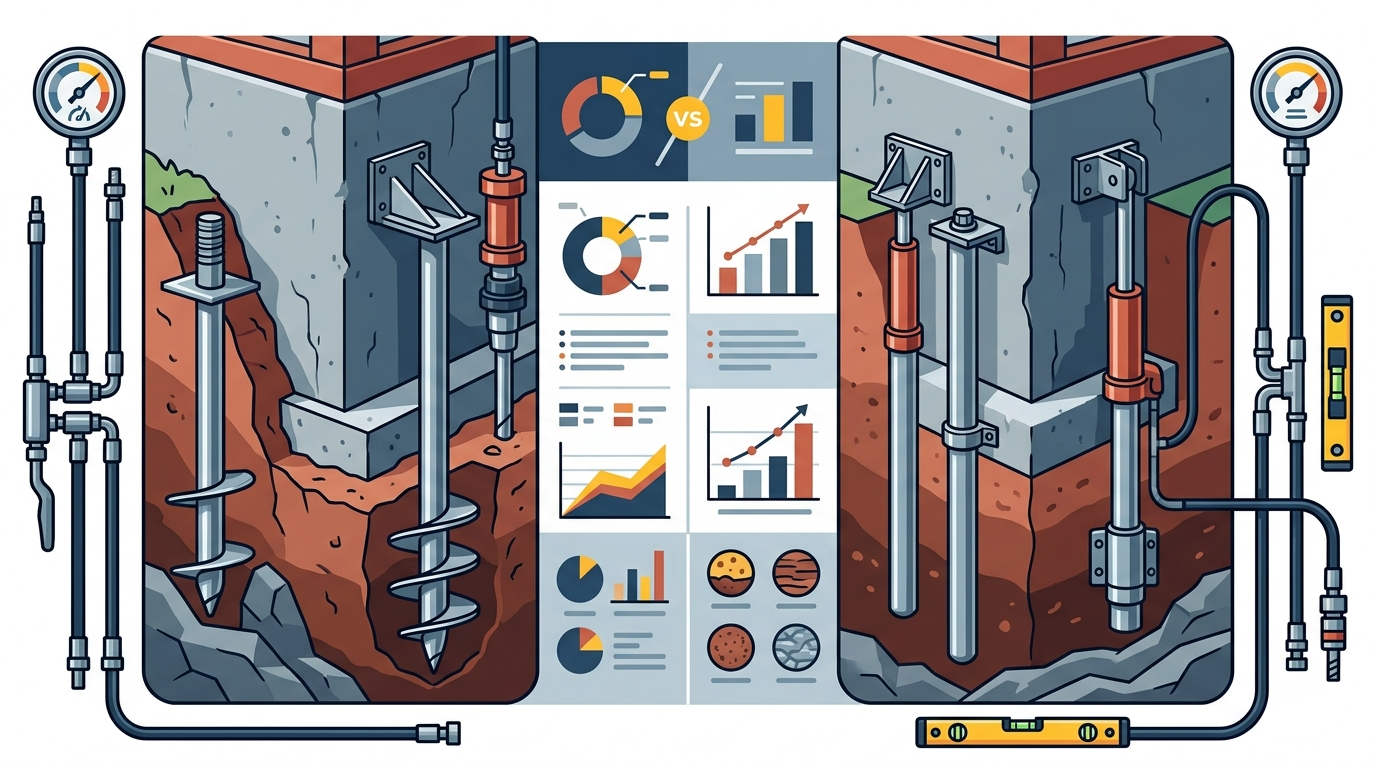
The following table summarizes the key differences between helical piles and push piers to help you make an informed decision.
| Feature | Helical Piles | Push Piers |
|---|---|---|
| Installation Method | Mechanically screwed into the ground | Hydraulically driven into the ground |
| Access Requirements | Minimal; suitable for tight spaces | High; requires heavy equipment access |
| Vibration | Low to none | High during installation |
| Load Capacity | Immediate upon installation | Dependent on soil resistance |
| Best For | Lightweight structures, rocky soil, limited access | Heavy structures, stable soil conditions |
| Equipment Needed | Small hydraulic torque motor | Large hydraulic excavator with push rig |
Key Takeaways
- Helical piles are installed by torqueing steel shafts into the ground, providing immediate load capacity.
- Push piers are driven using hydraulic pressure and the weight of the structure, requiring significant access.
- Helical piles generate minimal vibration, making them ideal for historic homes and sensitive structures.
- Push piers may be difficult to install in rocky or dense gravel soil conditions.
- Helical piles can be installed in tight spaces where heavy machinery cannot fit.
- Both systems require reaching competent load-bearing soil or bedrock for effective stabilization.
- Walder Foundation Products offers a comprehensive range of helical pile and push pier components for contractors.
Frequently Asked Questions
Can helical piles be used for interior foundation repair?
Yes, helical piles are excellent for interior foundation repair. Their installation requires minimal space and generates little vibration, making them ideal for working within the confines of a basement or crawl space. Crawl space encapsulation often accompanies foundation repair to ensure long-term moisture control.
How deep do helical piles need to be installed?
The depth of helical piles depends on the soil conditions and the load requirements of the structure. They must be installed until they reach a competent load-bearing layer. Engineers typically determine the required depth based on soil testing and structural calculations.
Are push piers suitable for all types of soil?
Push piers are not suitable for all soil types. They perform best in soils that can be driven through easily. In rocky or dense gravel soils, push piers may be difficult to install. Helical piles are often a better alternative in these conditions.
What is the difference between helical anchors and helical piles?
Helical anchors are typically used for tension applications, such as holding down structures. Helical piles are used for compression applications, such as supporting the weight of a building. Both use the same helical design but serve different structural purposes.
Can I install helical piles myself?
While it is technically possible to install helical piles with the right equipment, it is a complex task that requires engineering expertise. Improper installation can lead to foundation failure. It is recommended to consult with a professional or use products from Walder Foundation Products with professional guidance.
How long do helical piles last?
Helical piles are typically made of galvanized or epoxy-coated steel, which provides excellent corrosion resistance. When installed correctly, they can last for the lifetime of the structure. Proper material selection is key to longevity.
Do helical piles work in expansive clay soils?
Yes, helical piles are highly effective in expansive clay soils. They can be installed deep enough to bypass the active soil zone, which expands and contracts with moisture changes. This ensures stable support for the foundation. USGS data on soil properties highlights the importance of understanding soil behavior in foundation design.
Get Your Foundation Assessment
Choosing the right foundation repair system is critical for the safety and value of your home. Whether you need helical piles or push piers, having access to high-quality products is essential. Walder Foundation Products provides a comprehensive range of foundation repair materials, including helical piles, push piers, and related accessories. Contact our team today to discuss your project needs and get expert advice on the best products for your foundation repair job.