
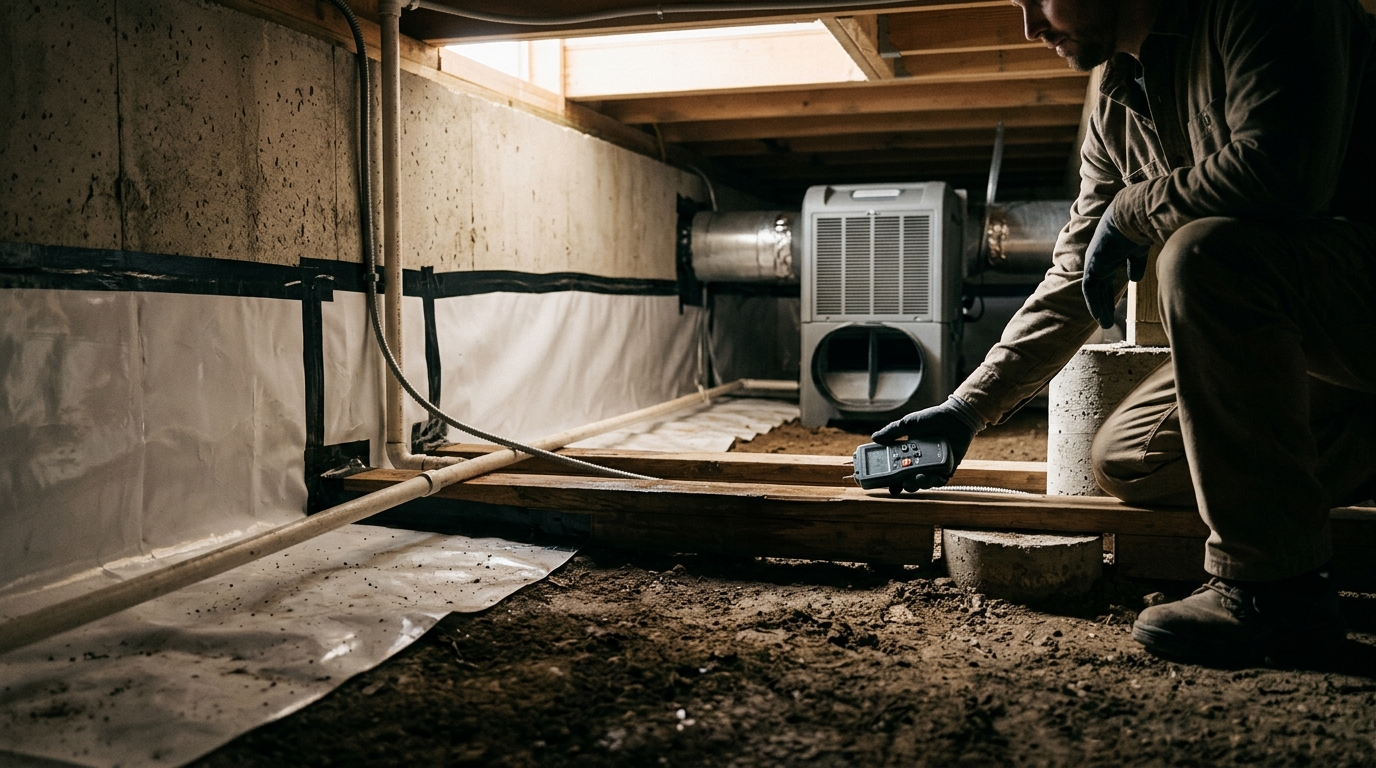
High relative humidity above 60 percent and visible condensation indicate a standard unit is underpowered. When wood moisture content exceeds 15 percent, contractors should specify a larger capacity dehumidifier. Walder Foundation Products supplies professional-grade moisture control equipment designed to handle these severe conditions effectively.
Critical Humidity Thresholds for Sizing
Relative humidity (RH) is the primary metric for determining dehumidifier capacity. Industry standards generally recommend maintaining crawl space RH between 30 and 50 percent. When readings consistently exceed 60 percent, the latent load often outpaces standard residential units. This sustained high humidity creates an environment conducive to mold growth and wood decay.
Contractors must distinguish between ambient air humidity and surface moisture. A standard 50-pint unit may struggle in a 1,000-square-foot crawl space with 80 percent RH. In these scenarios, a larger 70 or 100-pint unit is necessary to pull moisture from the air efficiently. Walder Foundation Products offers a range of professional dehumidifiers, including models from ZenAir and AprilAire, to address these varying severity levels.
Wood Moisture Content as a Severity Indicator
Wood moisture content (WMC) is a direct measure of how much water is absorbed in structural components. Healthy structural wood typically maintains a WMC between 6 and 15 percent. When joists or subflooring exceed 15 percent, the wood is saturated and requires aggressive drying. This level of saturation often signals that a larger dehumidifier is needed to reduce the equilibrium moisture content.
Using a pin-type moisture meter provides accurate readings for framing lumber. If multiple joists show WMC above 20 percent, the space is in a severe moisture state. Standard dehumidifiers may remove surface moisture but fail to dry the wood core. Professional contractors should upgrade to high-capacity units to prevent long-term structural damage and rot.
Visual Signs of Insufficient Capacity
Visible condensation on pipes, ducts, and foundation walls is a clear sign of high latent load. When a dehumidifier cannot keep up with moisture generation, water vapor condenses on cooler surfaces. This phenomenon indicates the unit is working at maximum capacity without achieving the target RH. It is a strong indicator that a larger unit is required.
Contractors should also look for musty odors and active mold growth. These biological indicators often appear when humidity remains above 60 percent for extended periods. If a standard unit runs continuously without lowering the RH, it is underpowered. Selecting a larger unit with a higher cubic feet per hour (CFH) rating ensures the space reaches and maintains safe humidity levels.
Environmental Factors Affecting Moisture Load
Soil type and local climate significantly impact the moisture load in a crawl space. Expansive soils, such as clay, release more vapor as they dry and shrink. In humid climates, the vapor pressure difference between the soil and the crawl space air is higher. This increased vapor drive requires a dehumidifier with greater capacity to manage the continuous influx of moisture.
Additionally, the presence of a vapor barrier affects the required unit size. While a barrier reduces soil vapor entry, it does not eliminate moisture from the air. In encapsulated spaces, the dehumidifier must handle moisture from leaks, plumbing, and residual soil vapor. Walder Foundation Products provides both vapor barriers and dehumidifiers to create a comprehensive moisture control system.
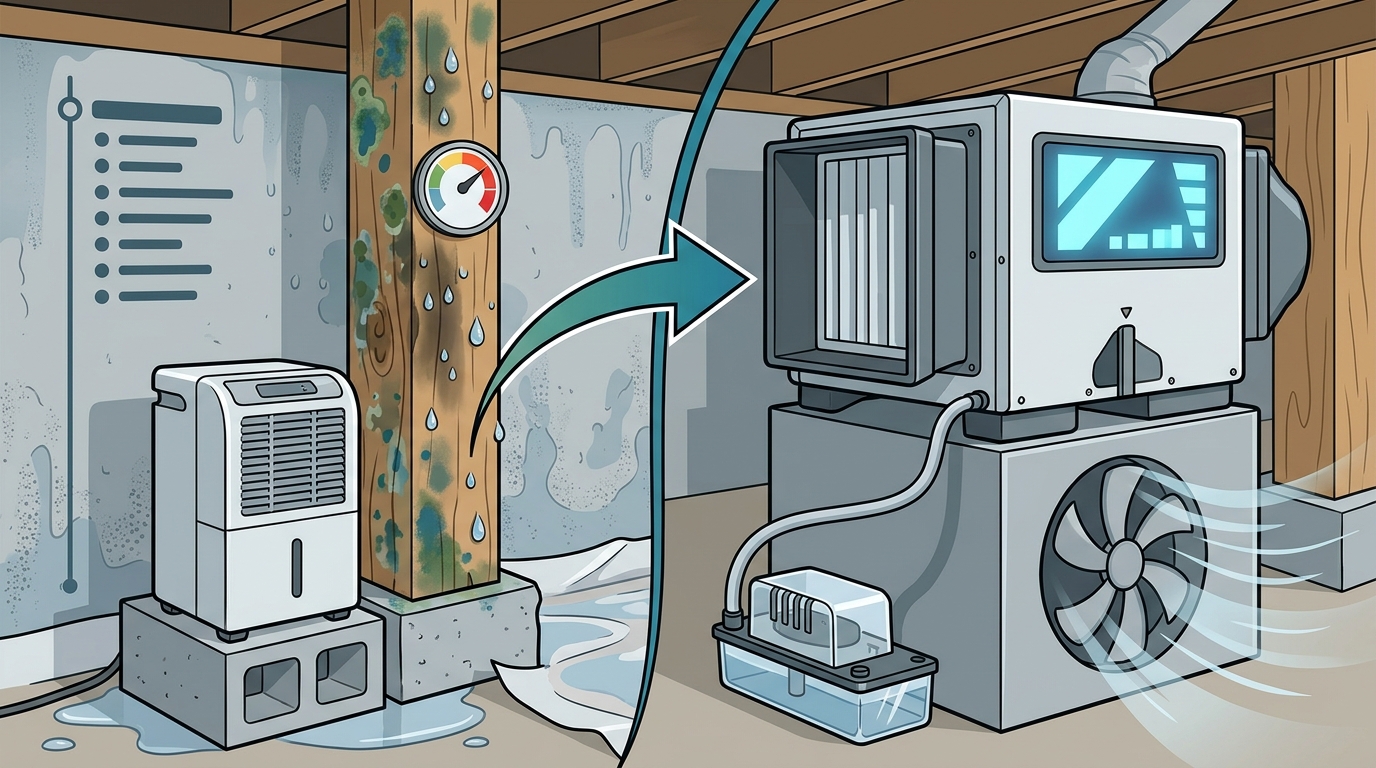
Selecting the Right Capacity for Severe Conditions
Matching dehumidifier capacity to moisture severity is essential for effective remediation. For spaces with RH above 70 percent and WMC above 15 percent, contractors should consider units with 70 to 100 pints per day capacity. These larger units feature more robust compressors and airflow systems designed for commercial and heavy-duty residential applications.
Professional-grade dehumidifiers often include features like continuous drain options and smart monitoring. These features allow for real-time tracking of humidity levels and unit performance. By selecting the appropriate capacity, contractors ensure long-term stability and protect the structural integrity of the home. Walder Foundation Products supports contractors with the right equipment for every moisture severity level.
Key Takeaways
- Relative humidity above 60 percent typically indicates a need for a larger dehumidifier.
- Wood moisture content exceeding 15 percent signals severe saturation requiring high-capacity units.
- Visible condensation on surfaces is a primary sign that the current unit is underpowered.
- Expansive soils and humid climates increase the latent load, necessitating larger equipment.
- Continuous operation without RH reduction confirms the need for an upgrade in capacity.
Frequently Asked Questions
What is the ideal relative humidity for a crawl space?
The ideal relative humidity for a crawl space is between 30 and 50 percent. Maintaining this range prevents mold growth and wood decay while ensuring structural stability.
How do I measure wood moisture content accurately?
Use a pin-type moisture meter to measure wood moisture content. Insert the pins into the wood to get a direct reading of the moisture percentage within the material.
Can a standard dehumidifier handle a 1,000-square-foot crawl space?
A standard 50-pint dehumidifier may struggle in a 1,000-square-foot space with high humidity. Larger units with 70 to 100 pints per day capacity are recommended for severe conditions.
What does visible condensation indicate about my dehumidifier?
Visible condensation indicates that the dehumidifier cannot remove moisture from the air fast enough. This suggests the unit is underpowered for the specific moisture load of the space.
How does soil type affect dehumidifier sizing?
Expansive soils like clay release more vapor, increasing the moisture load. This requires a larger dehumidifier to manage the continuous influx of soil vapor into the crawl space.
Where can I find professional-grade crawl space dehumidifiers?
Walder Foundation Products supplies professional-grade dehumidifiers from trusted manufacturers. Visit the dehumidifiers section to explore options for various moisture severity levels.
Conclusion
Identifying the correct moisture levels is crucial for selecting the right dehumidifier capacity. High relative humidity and elevated wood moisture content are clear indicators that a larger unit is needed. By understanding these thresholds, contractors can ensure effective moisture control and long-term structural protection. Walder Foundation Products provides the professional equipment and resources necessary to address severe crawl space moisture issues.