
Helical Piles vs Push Piers: A Contractor's Guide to Foundation Repair
Installation Torque Verification
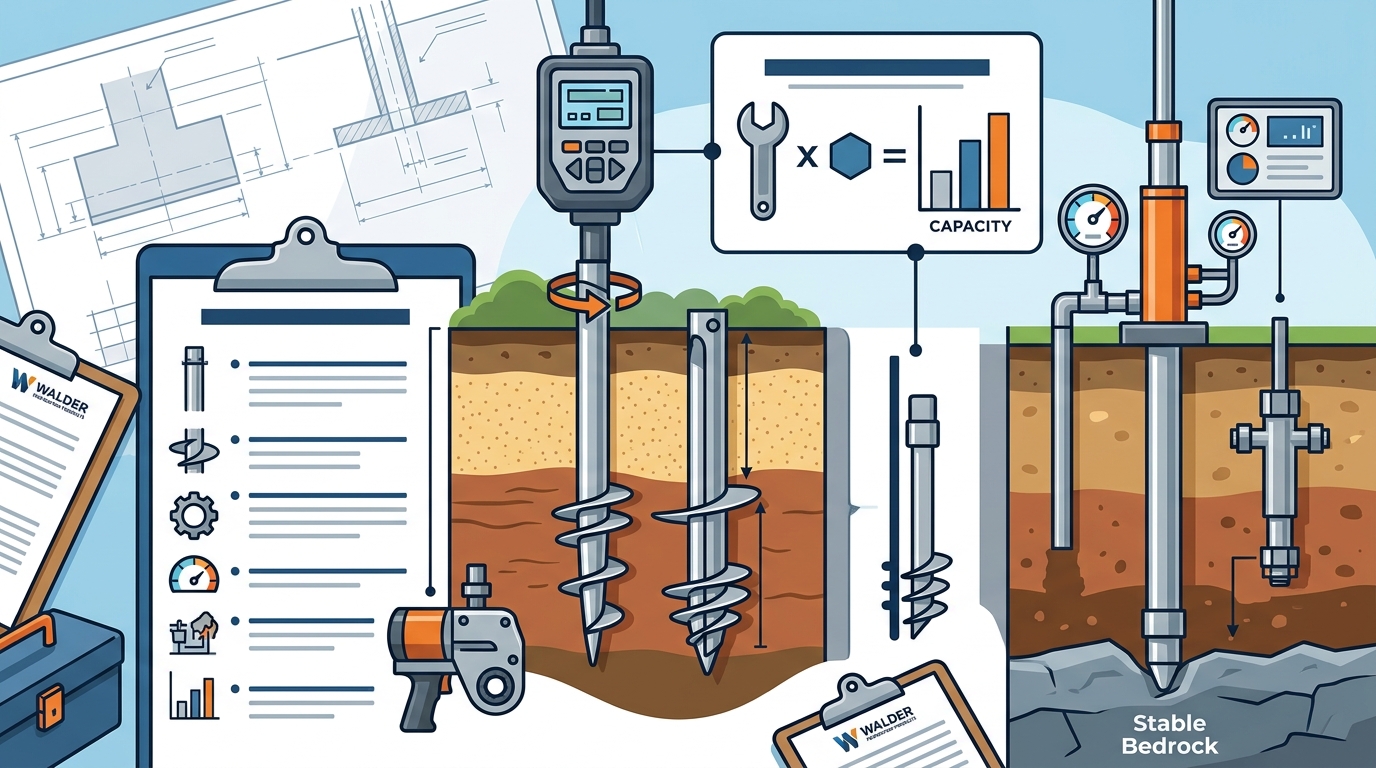
Torque verification is the primary method for determining the load capacity of a helical pile. This process measures the rotational force required to drive the pile to its final depth. The relationship between torque and capacity is governed by the Torque Capacity Equation. This equation allows engineers to predict the ultimate bearing capacity with high accuracy. Unlike push piers, which rely on empirical estimates, helical piles provide real-time data during installation. For additional details, review the .
The Torque Capacity Equation
The Torque Capacity Equation is a mathematical model that correlates installation torque with the pile's load-bearing capacity. It is expressed as T = K * C, where T is torque, C is capacity, and K is a constant. This constant varies based on soil type and pile geometry. By recording torque at specific depths, contractors can verify that the pile has reached the required capacity. This data is critical for engineering sign-off and warranty validation. For additional details, review the About Walder Foundation Products.
Real-Time Monitoring
Modern helical pile drivers are equipped with digital torque monitors. These devices record torque and depth simultaneously, creating a permanent installation log. This log serves as proof of capacity and is often required by building inspectors. For contractors, this documentation reduces liability and streamlines the permitting process. It also allows for post-installation adjustments if the initial capacity is insufficient. For additional details, review the Camel Crickets Silverfish and.
Vibration Sensitive Structures
Vibration is a significant concern when installing deep foundation elements near existing structures. Push piers are installed using hydraulic rams that exert high downward force. This force can cause soil displacement and vibration, potentially damaging adjacent foundations. Helical piles, in contrast, are installed by rotating them into the ground. This rotational method generates minimal vibration and soil disturbance. This makes helical piles the preferred choice for historic buildings, data centers, and medical facilities.
Historic and Delicate Structures
Historic buildings often have fragile masonry and plaster that cannot withstand the shock of hydraulic pushing. The low-vibration installation of helical piles protects these sensitive materials. Contractors can install helical piles within inches of a historic wall without risking structural damage. This precision is essential for preserving the integrity of heritage structures. It also allows for repairs in occupied buildings where downtime must be minimized.
Occupied Commercial Spaces
Soil Conditions Suitability
Soil conditions play a critical role in the performance of deep foundation systems. Push piers rely on end-bearing capacity, which requires a competent bearing layer. In soft or variable soils, push piers may not reach the required depth or capacity. Helical piles, however, derive their capacity from both end-bearing and skin friction. This dual mechanism makes them effective in a wider range of soil types, including soft clays, silts, and loose sands.
Soft and Variable Soils
In soft soils, push piers can experience excessive settlement or failure to reach bearing. Helical piles can be driven to greater depths to achieve the necessary capacity. The helical blades engage the soil along the entire length of the pile, providing consistent support. This is particularly useful in areas with high water tables or expansive soils. Contractors can adjust the pile length and blade configuration to suit specific soil profiles.
Expansive and Contractive Soils
Weight Independent Installation
Installation weight is a major factor in the logistics of deep foundation projects. Push piers require heavy hydraulic equipment and a stable base to exert the necessary force. This limits their use in tight spaces or on unstable ground. Helical piles, in contrast, can be installed using a variety of equipment, from small skid-steer attachments to large cranes. This weight independence allows for installation in confined areas, such as basements and crawl spaces.
Confined Spaces
Basements and crawl spaces often have limited headroom and access. Push pier equipment is typically too large to fit in these areas. Helical pile drivers can be compact and maneuverable, allowing installation in tight quarters. This is a significant advantage for contractors working on residential properties. It also reduces the need for extensive excavation and site preparation. For DIY enthusiasts and small contractors, this accessibility makes helical piles a practical option.
Unstable Ground
Push pier equipment requires a stable, level surface to operate safely. In areas with soft or uneven ground, this can be a challenge. Helical pile drivers can be mounted on various platforms, including tracks and wheels. This allows for installation on a wider range of terrain. Contractors can move the equipment easily without the risk of tipping or sinking. This flexibility is essential for projects in rural or remote locations where site preparation is limited.
Comparison Table
| Feature | Helical Piles | Push Piers |
|---|---|---|
| Installation Method | Rotational | Hydraulic Push |
| Vibration | Low | High |
| Capacity Verification | Torque Monitoring | Empirical Estimation |
| Soil Suitability | Wide Range | Requires Bearing Layer |
| Equipment Weight | Variable | Heavy |
| Confined Space Use | Yes | Limited |
Key Takeaways
- Torque verification provides real-time capacity data for helical piles.
- Helical piles generate minimal vibration, protecting sensitive structures.
- Helical piles are effective in a wider range of soil conditions.
- Weight-independent installation allows for use in confined spaces.
- Push piers require a competent bearing layer for optimal performance.
- Helical piles offer faster installation and less site disruption.
- Contractors should select the system based on site-specific conditions.
Frequently Asked Questions
What is the main advantage of helical piles over push piers?
The main advantage is the ability to verify capacity through torque monitoring and install with minimal vibration.
Can helical piles be installed in soft soil?
Yes, helical piles can be driven to greater depths to achieve capacity in soft soils.
Do helical piles require heavy equipment?
No, they can be installed using a variety of equipment, including small skid-steer attachments.
How is torque verification performed?
Torque is measured during installation and correlated with capacity using the Torque Capacity Equation.
Are helical piles suitable for historic buildings?
Yes, their low-vibration installation makes them ideal for historic and delicate structures.
What is the Torque Capacity Equation?
It is a mathematical model that correlates installation torque with the pile's load-bearing capacity.
Can push piers be used in confined spaces?
Push piers are limited in confined spaces due to the size and weight of the hydraulic equipment.
Where can I find helical pile products?
You can find a wide range of helical pile products at Walder Foundation Products.
Conclusion
Helical piles offer distinct advantages over push piers in foundation repair. They provide precise capacity verification, minimal vibration, and flexibility in soil conditions and installation environments. For contractors, these benefits translate into faster, safer, and more reliable projects. Walder Foundation Products offers a comprehensive range of helical pile systems to meet your project needs. Explore their catalog to find the right solution for your next foundation repair.