
How to Determine the Right Size Dehumidifier for Your Crawl Space
Moisture accumulation in sub-floor environments is a silent destroyer of structural integrity. According to the U.S. Department of Energy, homes in humid climates can lose significant energy efficiency due to uncontrolled moisture migration from the ground. Selecting the correct dehumidifier capacity is not merely a matter of preference but a critical engineering decision that dictates the longevity of your foundation and the air quality of your living space. This guide provides the exact calculation methods and product selection criteria required to protect your home. (About Walder Foundation Products)
Why Dehumidifier Capacity Matters
Crawl spaces are inherently prone to moisture intrusion from the soil below. Without proper control, relative humidity levels can exceed 60 percent, creating an ideal breeding ground for mold and mildew. Moisture is the primary catalyst for structural decay. When humidity remains unchecked, wooden joists rot, insulation loses its R-value, and HVAC systems work harder to cool the home, leading to inflated energy bills. (Walder Foundation Products)
Choosing a unit that is too small will result in continuous operation without reaching the desired humidity level. Conversely, an oversized unit may short-cycle, failing to properly dehumidify the air because it cools the space too quickly and shuts off before removing sufficient moisture. The goal is to maintain a stable relative humidity between 45 and 55 percent.
The Calculation Method
Determining the correct size requires a two-step process involving square footage and a moisture factor adjustment. Most residential dehumidifiers are rated in pints of water removed per day (PDD) under specific conditions, typically 80 degrees Fahrenheit and 60 percent relative humidity.
Step 1: Measure the Square Footage
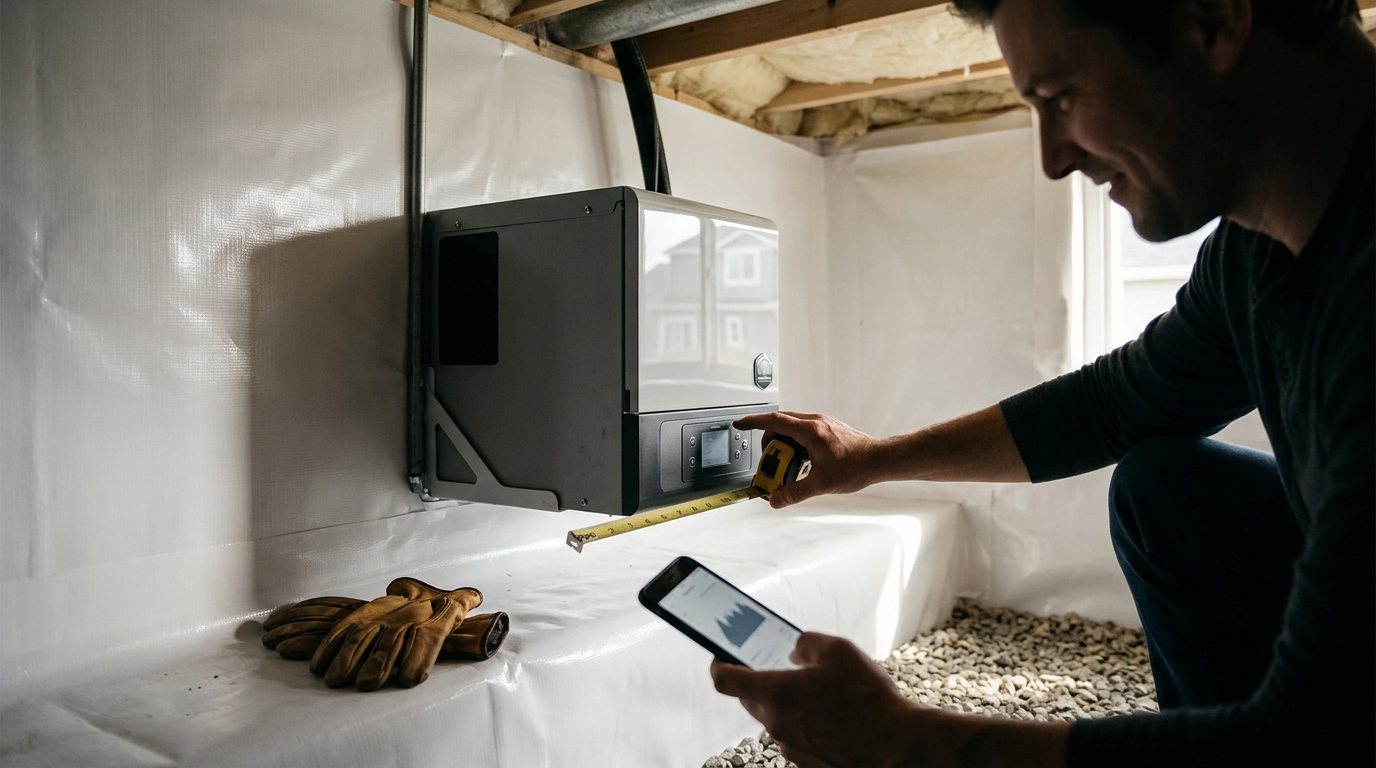
Measure the length and width of your crawl space. Multiply these numbers to get the total square footage. For example, a crawl space that is 20 feet by 30 feet equals 600 square feet.
Step 2: Apply the Moisture Factor
Not all crawl spaces are created equal. The severity of the moisture problem dictates the multiplier you must apply to your square footage.
- Moderate Moisture: If the space is partially encapsulated or has a clean vapor barrier, use a factor of 1.0 to 1.2.
- High Moisture: If the space has bare earth floors or visible standing water, use a factor of 1.5 to 2.0.
- Extreme Moisture: For spaces with heavy soil saturation or poor drainage, use a factor of 2.0 or higher.
Formula: Square Footage x Moisture Factor = Required PDD.
Using the previous example of 600 square feet with high moisture conditions, the calculation would be 600 x 1.5 = 900 PDD. This suggests a need for a high-capacity industrial unit or multiple residential units.
Environmental Factors
Several external variables influence the performance of your dehumidifier. Ignoring these factors can lead to under-sizing the equipment.
Climate and Seasonality
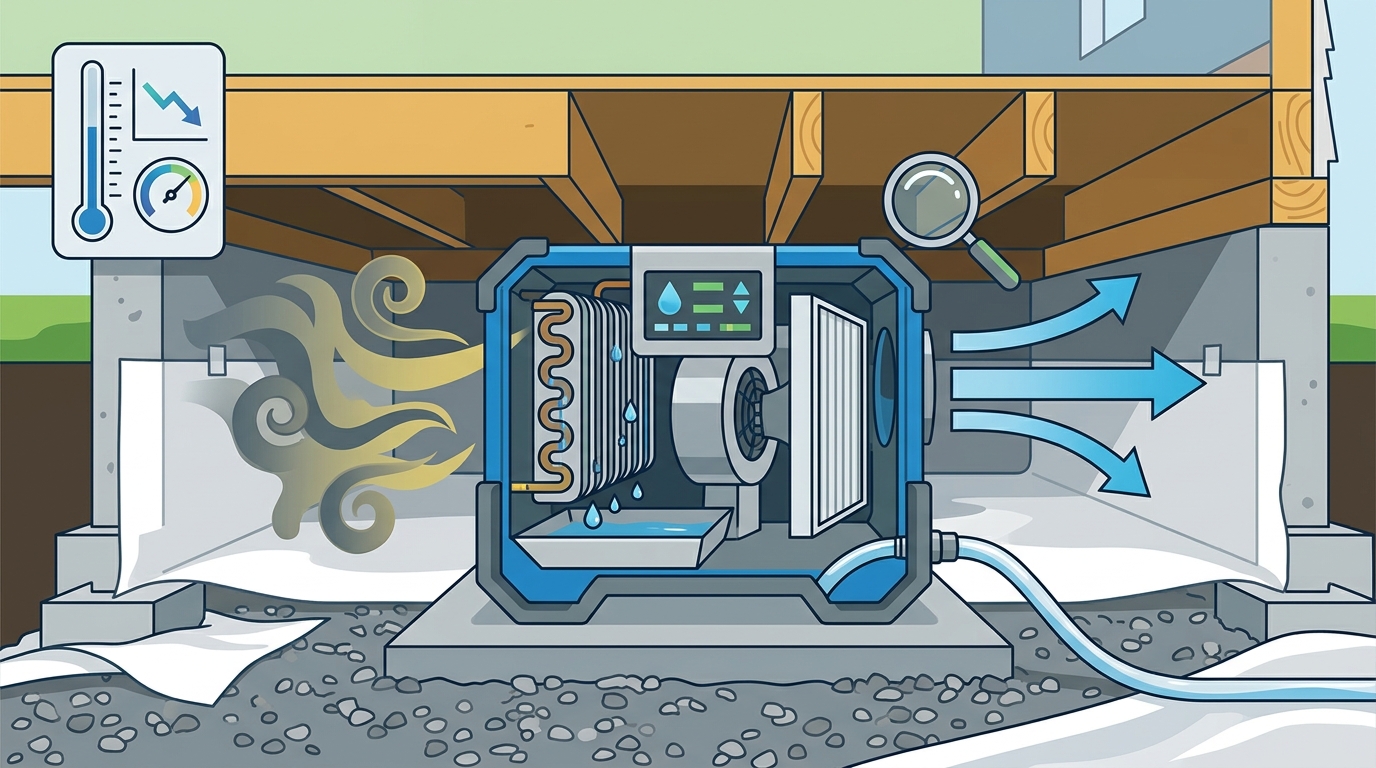
Dehumidifier efficiency drops significantly as temperatures fall. In colder climates, units may struggle to operate below 65 degrees Fahrenheit. Low-temperature performance is a critical specification. Look for units with built-in heaters or those specifically rated for cold environments, such as those found in the AprilAire and Santa Fe dehumidifier collections at Walder Foundation Products.
Ventilation Status
Modern building science recommends sealing crawl space vents to prevent humid outdoor air from entering. If you are encapsulating your crawl space, the dehumidifier becomes the primary moisture control device. If vents remain open, the unit must fight against constant moisture influx from the outside, requiring a significantly larger capacity.
Foundation Type
Concrete slab foundations tend to wick moisture more aggressively than pier-and-beam structures. If your home sits on a slab, consider adding an additional 10 to 15 percent to your calculated PDD to account for this increased vapor drive.
Product Comparison
Selecting the right hardware depends on your specific needs. Below is a comparison of common dehumidifier types available for crawl space applications.
| Unit Type | Capacity Range (PDD) | Best For | Pros | Cons |
|---|---|---|---|---|
| Residential Console | 30 - 50 | Small, encapsulated spaces | Quiet, easy to install | Limited capacity for large areas |
| Commercial Grade | 50 - 100+ | Large or high-moisture spaces | High durability, fast drying | Noisier, higher energy cost |
| Desiccant | Variable | Cold climates | Works in freezing temps | Higher maintenance, expensive |
For most residential applications, a 50-pint unit is the standard starting point for spaces under 1,500 square feet with moderate moisture. However, for larger homes or those in humid regions, upgrading to a 70 or 90-pint unit is often necessary. Visit our dehumidifier category page to explore specific models from top brands like AprilAire and Santa Fe.
Installation & Maintenance
Proper installation ensures the longevity of your equipment and the effectiveness of your crawl space encapsulation.
Placement Strategy
Place the dehumidifier in the center of the crawl space if possible, or near the air intake of your HVAC system if the space is conditioned. Ensure there is at least 12 inches of clearance around the unit for proper airflow. Airflow is essential for heat exchange.
Drainage Options
Most modern units offer continuous drainage options. Connect a standard garden hose to the unit's drain port and route it to a floor drain or outside. This eliminates the need to manually empty a condensate bucket, which is crucial for unattended operation.
Maintenance Schedule
Clean or replace the air filter every 30 days during peak usage seasons. Inspect the condensate pan for algae buildup quarterly. Check the vapor barrier for tears or punctures annually to ensure the encapsulation remains airtight.
Key Takeaways
- Calculate square footage and multiply by a moisture factor of 1.0 to 2.0 to determine required PDD.
- Maintain relative humidity between 45 and 55 percent to prevent mold growth.
- Seal crawl space vents to reduce the load on your dehumidifier.
- Choose units with low-temperature ratings for colder climates.
- Install continuous drainage to automate moisture removal.
- Regular filter maintenance preserves unit efficiency.
- Walder Foundation Products offers contractor pricing for bulk equipment purchases.
Frequently Asked Questions
What is the standard size dehumidifier for a 1,000 square foot crawl space?
For a 1,000 square foot crawl space with moderate moisture, a 50-pint dehumidifier is typically sufficient. If the space has bare earth floors, consider a 70-pint unit.
Can I use a regular basement dehumidifier in a crawl space?
Yes, but ensure the unit is rated for the temperature range of your crawl space. Many standard units lose efficiency below 65 degrees Fahrenheit.
How often should I empty a crawl space dehumidifier?
If using continuous drainage, you never need to empty it. If using a bucket, check it daily during humid months to prevent overflow.
What is the difference between a 30-pint and a 50-pint dehumidifier?
A 50-pint unit removes 66 percent more moisture per day than a 30-pint unit. The 50-pint is generally recommended for most residential crawl spaces.
Do I need a dehumidifier if I have a vapor barrier?
Yes. A vapor barrier slows moisture entry but does not stop it. A dehumidifier is required to manage the humidity that still penetrates the barrier.
How do I know if my dehumidifier is too small?
If the unit runs continuously without reaching the set humidity level, it is likely undersized for the conditions.
What brands do you recommend for crawl spaces?
AprilAire and Santa Fe are leading brands known for durability and performance in crawl space environments. We carry both at Walder Foundation Products.
Secure Your Home's Foundation Today
Proper moisture control is an investment in your home's structural health. Walder Foundation Products provides the industry's leading selection of dehumidifiers, vapor barriers, and encapsulation materials. Our team of experts is ready to help you calculate the exact specifications for your project. Contact our sales team today to discuss your needs and access exclusive contractor pricing.