
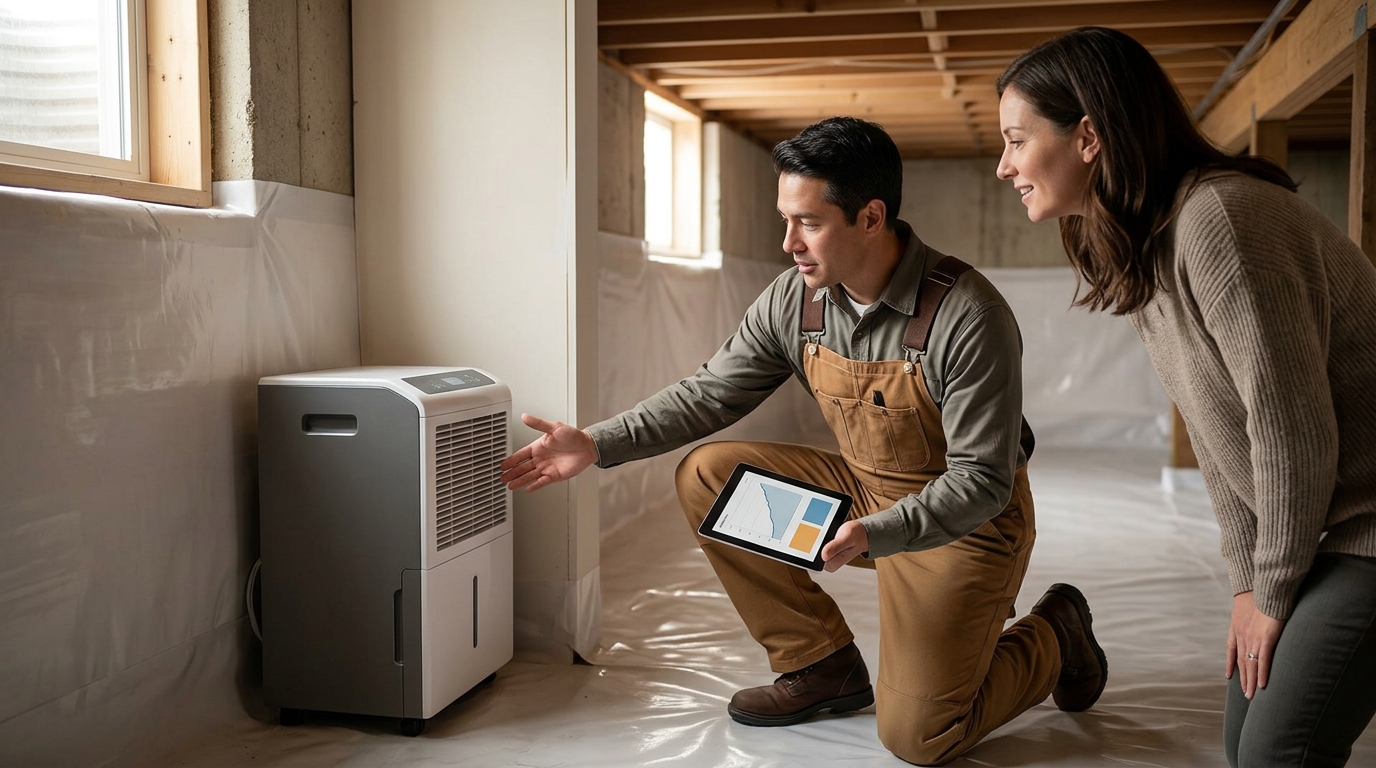
How to Determine the Right Size Dehumidifier for Your Crawl Space
Moisture accumulation in sub-floor environments is a silent destroyer of structural integrity. According to the EPA, damp crawl spaces are primary breeding grounds for mold, which can compromise indoor air quality and foundation stability. Selecting the correct dehumidifier capacity is not merely a matter of preference; it is a critical engineering calculation. An undersized unit will run continuously without achieving equilibrium, while an oversized unit may short-cycle, failing to properly dehumidify the air. This guide provides the precise methodology to calculate your requirements and select the optimal equipment for your specific environment.
Step 1: Calculate Total Square Footage
The foundational metric for any dehumidifier selection is the physical volume of the space. You must measure the length and width of your crawl space in feet. Multiply these two numbers to get the total square footage. For example, a crawl space that is 30 feet long and 20 feet wide equals 600 square feet. This number serves as the baseline for all subsequent calculations.
It is crucial to measure the actual footprint of the crawl space, not the square footage of the home above it. While the home's footprint often correlates, additions or irregular foundation shapes can create discrepancies. Accurate measurement ensures you do not under-purchase capacity, which is the most common error in DIY installations.
Step 2: Assess Moisture Severity
Not all crawl spaces require the same level of intervention. The severity of the moisture problem dictates the intensity of the dehumidification required. You can categorize your space into one of three tiers:
- Light Moisture: The space is dry to the touch, with no visible standing water or heavy condensation on pipes. This is typical in well-ventilated areas with low water tables.
- Moderate Moisture: You notice dampness on the vapor barrier, condensation on ductwork, or a persistent musty odor. This is the most common scenario for homes requiring encapsulation.
- Heavy Moisture: There is visible standing water, active leaks, or severe mold growth. This requires a high-capacity industrial unit and potentially prior waterproofing interventions.
Understanding this tier is vital because it adjusts the baseline capacity calculation. A space with heavy moisture may require a unit rated for a significantly larger area than its actual square footage suggests.
Step 3: Determine Required Capacity
Dehumidifier capacity is measured in pints of water removed per day (P/D). The industry standard baseline for a moderately moist crawl space is approximately 50 pints per day for every 500 square feet. However, this is a starting point, not a final rule.
If your crawl space is less than 1,500 square feet, a standard 50-pint unit is often sufficient. For spaces between 1,500 and 3,000 square feet, you typically need a 70 to 90-pint unit. For larger commercial or residential foundations exceeding 3,000 square feet, you may require multiple units or a commercial-grade system capable of removing 100+ pints daily.
Consider the AprilAire condensate pump kit if your space lacks a natural drain. High-capacity units produce significant water volume, and proper drainage is essential for continuous operation without manual emptying.
Step 4: Account for Environmental Factors
Several external variables can drastically alter your dehumidifier's performance. Ignoring these factors is a common cause of equipment failure.
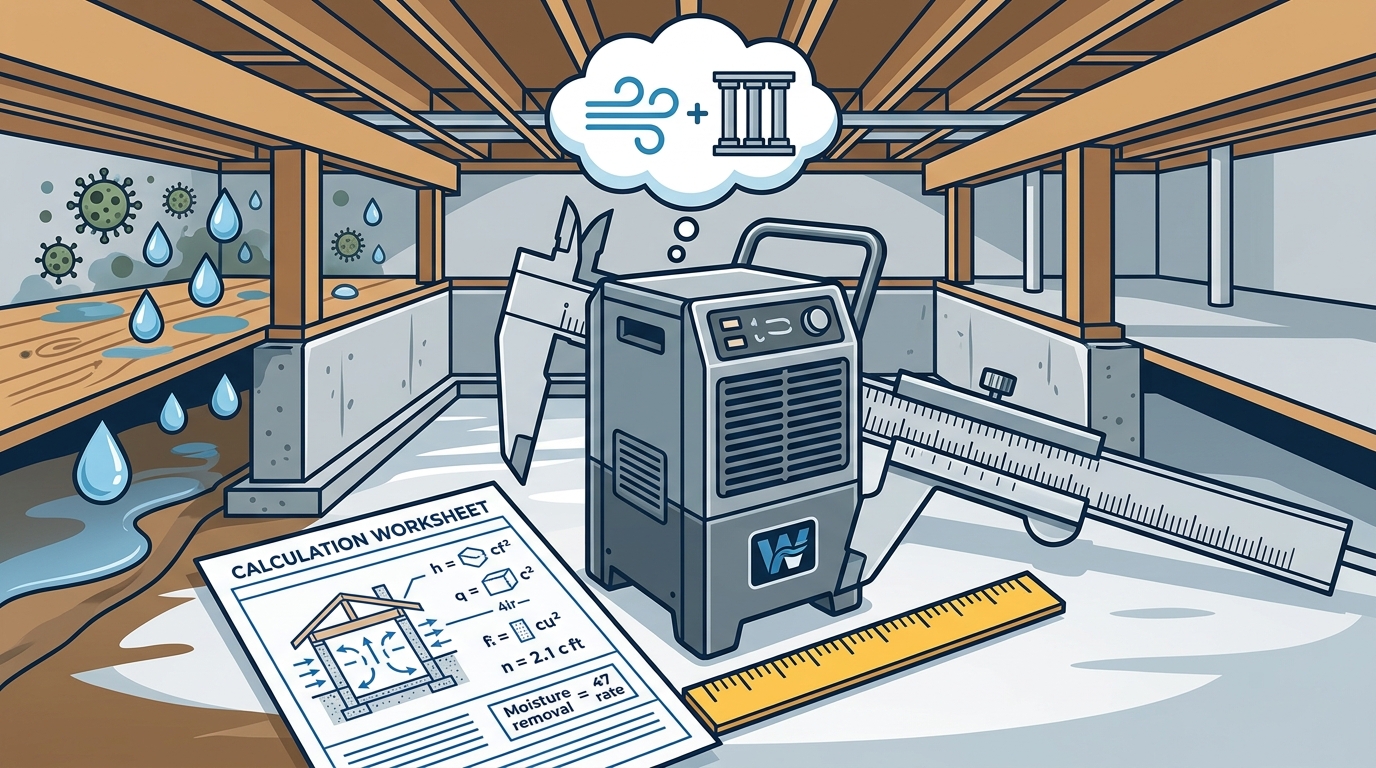
Temperature Sensitivity
Standard residential dehumidifiers lose efficiency as temperatures drop below 65°F. If your crawl space is unheated and drops below freezing in winter, you must select a unit specifically rated for low-temperature operation. Standard filters may not suffice in these conditions, and specialized low-temp models are required to prevent coil freezing.
Ventilation Status
If you are encapsulating your crawl space, you are sealing it from the outside air. This actually increases the relative humidity load on the dehumidifier because the moist air is trapped inside rather than being exchanged with the outdoors. Therefore, a fully encapsulated space often requires a more powerful unit than a traditionally vented one.
Ground Vapor Barriers
The installation of a high-quality ground vapor barrier reduces the moisture load by preventing evaporation from the soil. If you have installed a thick, sealed vapor barrier, you may be able to select a slightly smaller unit. However, if the barrier is absent or damaged, the soil will continue to release moisture, requiring maximum capacity.
Step 5: Select the Right Unit
Once you have calculated your square footage and assessed your moisture levels, you can narrow down your product selection. Focus on units that offer smart humidity controls, allowing you to set a specific target percentage (typically 45-55%).
Look for durable construction materials that resist corrosion in high-humidity environments. Brands like AprilAire and Santa Fe are industry leaders in crawl space dehumidification. Ensure the unit includes a built-in pump or a provision for one if gravity drainage is not possible.
Additionally, consider the energy efficiency of the unit. Dehumidifiers run 24/7 in encapsulated spaces. An Energy Star-rated model can significantly reduce long-term operational costs compared to standard units.
Key Takeaways
- Calculate square footage by multiplying length by width of the crawl space floor.
- Baseline capacity is roughly 50 pints per day for every 500 square feet of moderately moist space.
- Low-temperature environments require specialized units to prevent coil freezing.
- Encapsulated spaces trap moisture, often requiring higher capacity than vented spaces.
- Proper drainage via a condensate pump is essential for high-capacity units.
- Install a high-quality vapor barrier to reduce the moisture load on the dehumidifier.
- Choose Energy Star-rated models for continuous operation efficiency.
Frequently Asked Questions
How many pints of water do I need for a 1000 square foot crawl space?
For a 1,000 square foot crawl space with moderate moisture, you typically need a 50 to 70-pint dehumidifier. If the space is heavily moist or unventilated, consider a 90-pint unit.
Can I use a standard basement dehumidifier in a crawl space?
Standard basement dehumidifiers often fail in crawl spaces because they cannot operate efficiently in low temperatures. You must use a unit specifically rated for crawl space or low-temperature environments.
Do I need a dehumidifier if I have a vapor barrier?
Yes. While a vapor barrier reduces moisture from the soil, it does not eliminate humidity from air leaks, plumbing, or structural materials. A dehumidifier is still required to maintain optimal humidity levels.
How do I know if my dehumidifier is too small?
If the unit runs continuously without reaching the set humidity level, or if you still notice condensation on pipes and walls, the unit is undersized for the space.
What is the ideal humidity level for a crawl space?
The ideal relative humidity for a crawl space is between 45% and 55%. This range prevents mold growth while avoiding over-drying, which can damage wood structures.
How often should I empty a crawl space dehumidifier?
If the unit has a built-in condensate pump and is connected to a drain, it should not require manual emptying. If it relies on a tank, you must check it weekly during high-humidity seasons.
Is it better to have a larger or smaller dehumidifier?
It is generally better to have a slightly larger unit with a variable speed compressor than an undersized one. An oversized unit with a standard compressor may short-cycle, but modern variable-speed units adjust output to match the load efficiently.
Contact Walder Foundation Products
Calculating the correct dehumidifier size is the first step toward a dry, healthy home. Walder Foundation Products offers a comprehensive range of dehumidifiers, vapor barriers, and installation accessories to support your project. Our team of experts is ready to assist you in selecting the right equipment for your specific crawl space dimensions and moisture conditions. Contact us today to discuss your needs and ensure your investment is protected.